Product matching
How to compare products without a shared EAN
In furniture, two competing offers rarely share an EAN or GTIN. To compare them, you have to recognize the product another way: by its specifications, its text and above all its photos.
Key points
- The GTIN, also known as EAN or UPC, identifies a trade item. Private labels and renamed models almost never share one.
- There are three levels of equivalence: the same item, the same model under another name, and the functional equivalent.
- A sound method combines measurable specifications, text and photos, then lets a person decide the doubtful cases.
- Classic traps: color variants, sets of chairs, and package dimensions mistaken for the furniture's own.
Why the EAN is not enough in furniture
The GTIN, better known as the EAN in Europe and the UPC in North America, uniquely identifies a trade item. It is assigned by the company that markets the product, from a prefix issued by GS1[1]. When two sites show the same GTIN, the comparison is immediate.
In furniture, that is the exception. Many retailers sell products under their own brand; a single manufacturer supplies several distributors who rename the model; and many sites simply do not publish the code. Google acknowledges it in its documentation: a product sold under a store brand generally has no GTIN, and the example given is precisely a couch, to be identified by its brand and manufacturer part number[2].
The upshot: to know who sells your sofa, or a sofa your customers will compare with yours, you have to recognize the product some other way.
Three levels of equivalence
Before any method, decide what you are looking for.
- The same item. Same product, same manufacturer, sold elsewhere, sometimes under the same name.
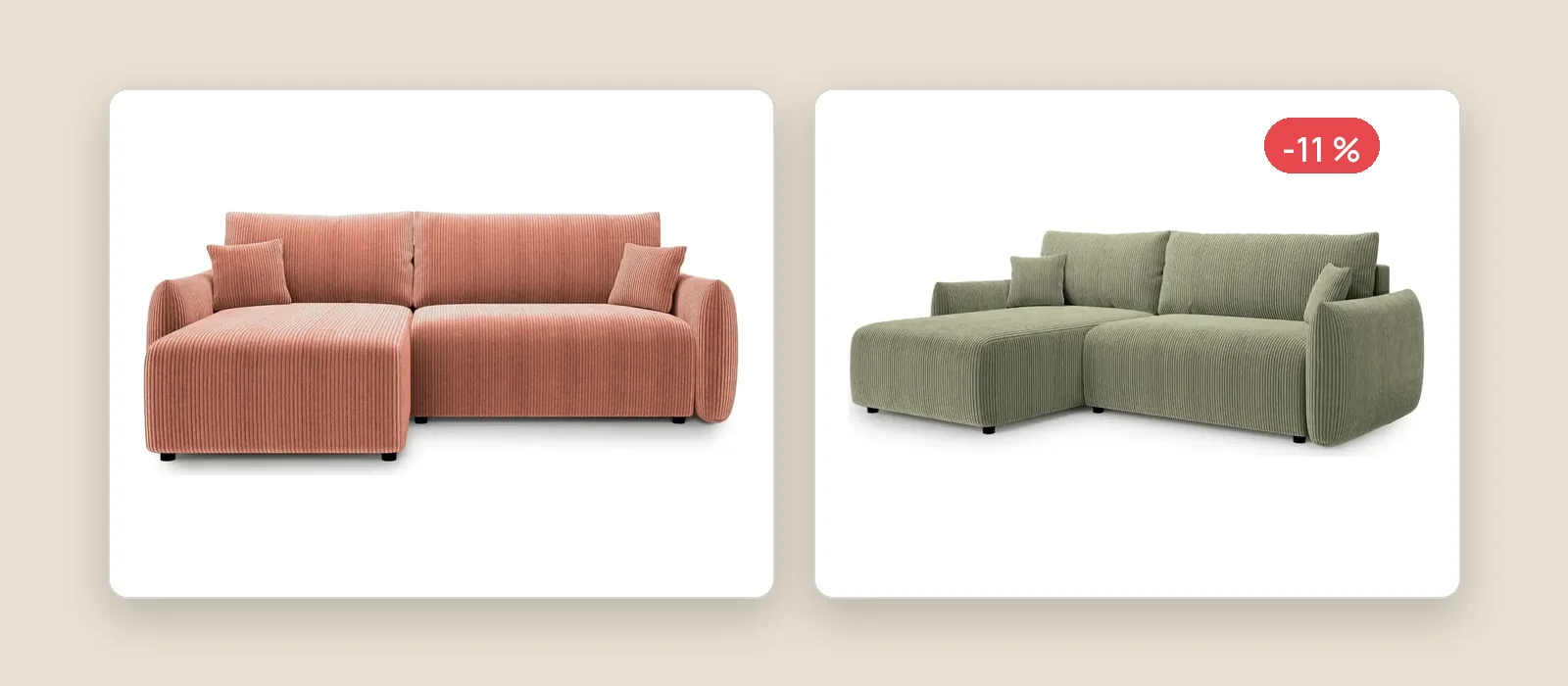
- The same model under another name. Same structure, dimensions and materials, but a different name, different photos and sometimes a different color. This is often called a factory copy.
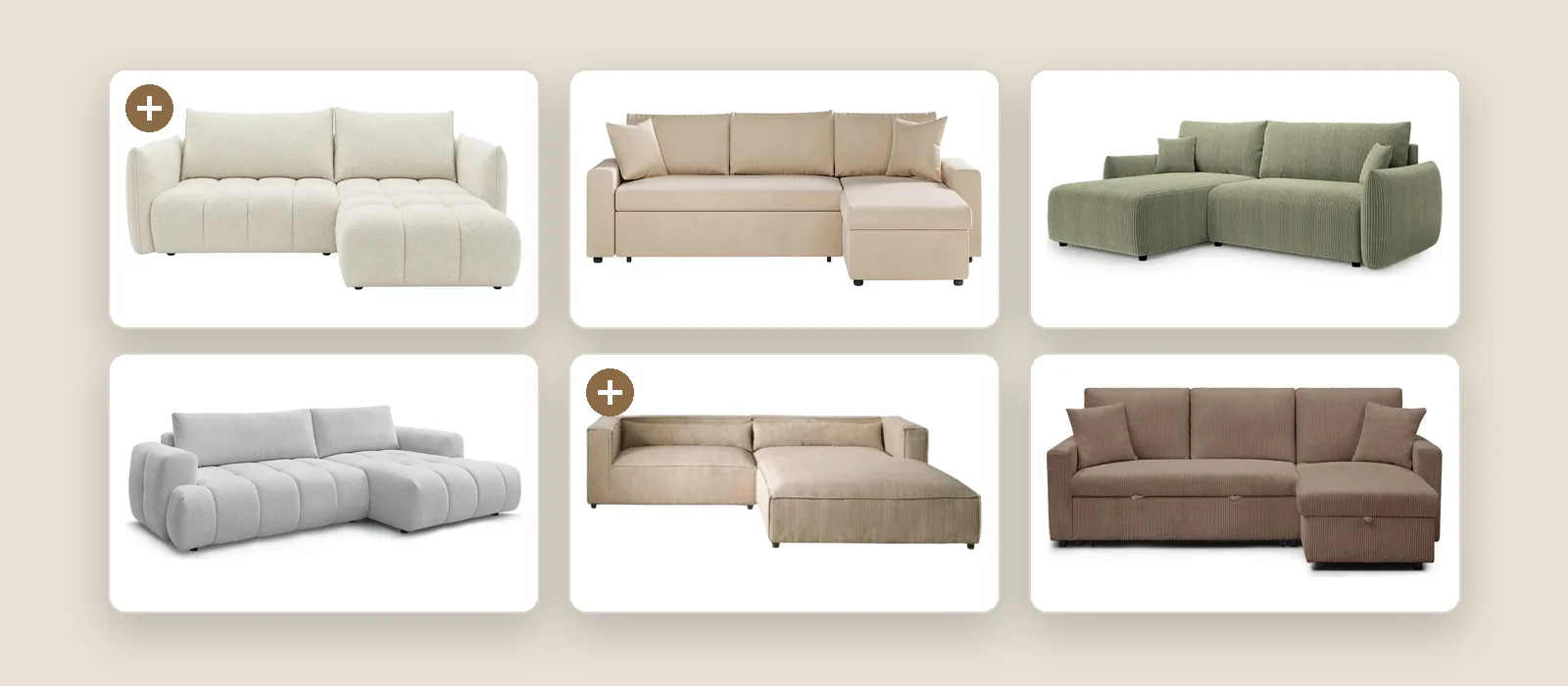
- The functional equivalent. Another product that customers still weigh against yours: same seat count, close dimensions, same function, similar price range.
The first two levels answer “who sells my product?”. The third answers “who am I competing with?”. Both matter, but they are not handled the same way.
Method 1: measurable specifications
Technical attributes are the foundation of any comparison. For a sofa, keep at least:
- width, depth and height;
- seat count;
- corner orientation (left, right, reversible);
- functions: sofa bed, storage, recliner;
- main material and type of legs.
Set tolerances per dimension rather than one global threshold. Ten centimeters of difference do not weigh the same in width as in height.
The limit of this method is the quality of product pages. Dimensions are often missing, or describe the package rather than the furniture. You need to read them wherever the site publishes them, sometimes on a dimensioned drawing.
Method 2: titles and descriptions
Text gives useful clues: a model name, a material, a seat count. Before comparing it, clean it up:
- remove color and texture words, which change from one variant to the next;
- isolate the model name, often written in capitals;
- bring units to a common format.
Used alone, text misleads. Two sofas with different names can be identical, and two sofas with nearly identical titles can differ in size.
Method 3: photos
In furniture, a product's identity is first of all visual. Computer vision models turn a photo into a numeric description that can be compared with thousands of others in milliseconds. Two families of models dominate: those trained by pairing images with text, and those trained on images alone.
These general models recognize an object's category well, and the details that separate two nearly identical corner sofas less well. Fine-tuning them on furniture pairs validated by people makes a clear difference to accuracy. Two precautions also matter: prefer cut-out photos on a plain background to lifestyle shots, and compare several views of the same product when they exist.
Combine, then have people validate
No method is enough on its own. A sound method chains them:
- Proven identity first: if an EAN or a manufacturer reference links two products, the question is settled.
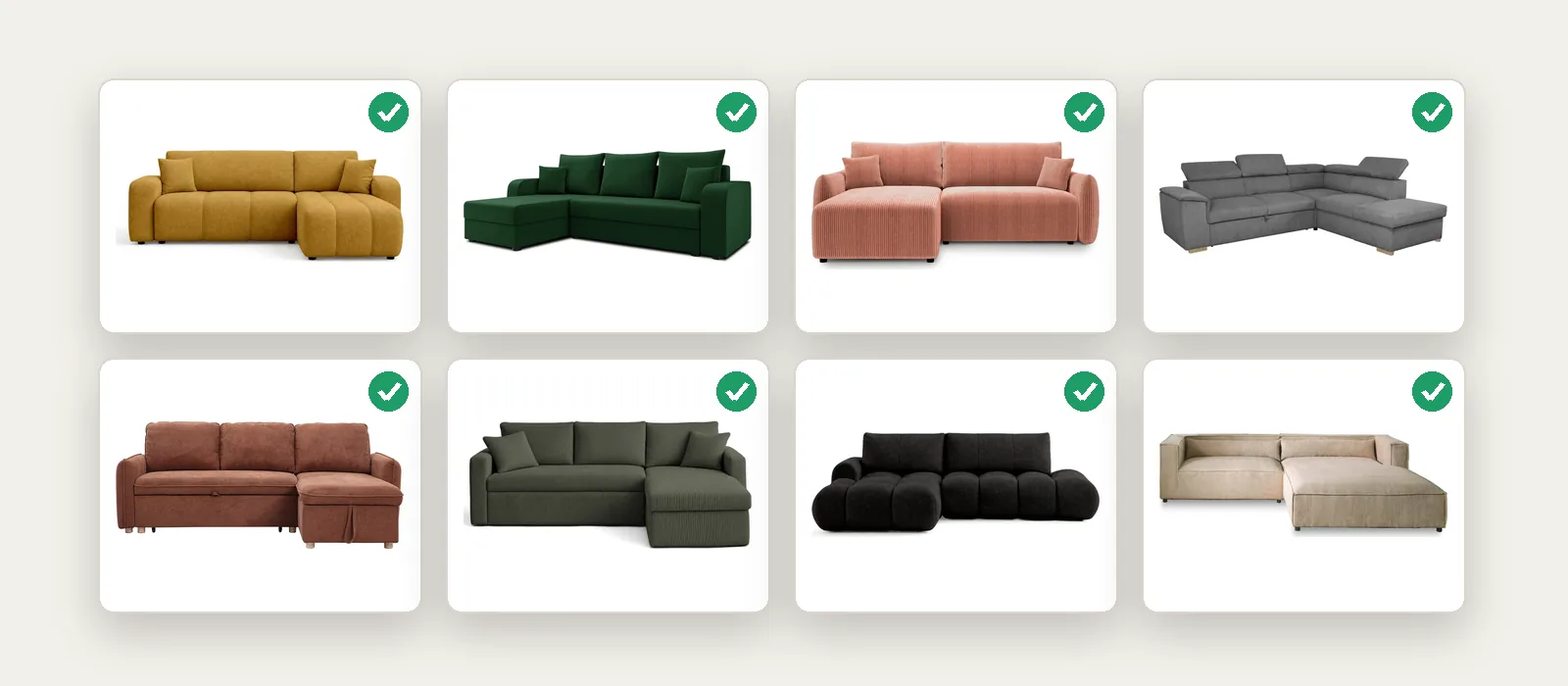
- Photos next, to find close candidates across the whole market.
- A strict filter on dimensions, seats and functions, to rule out false friends.
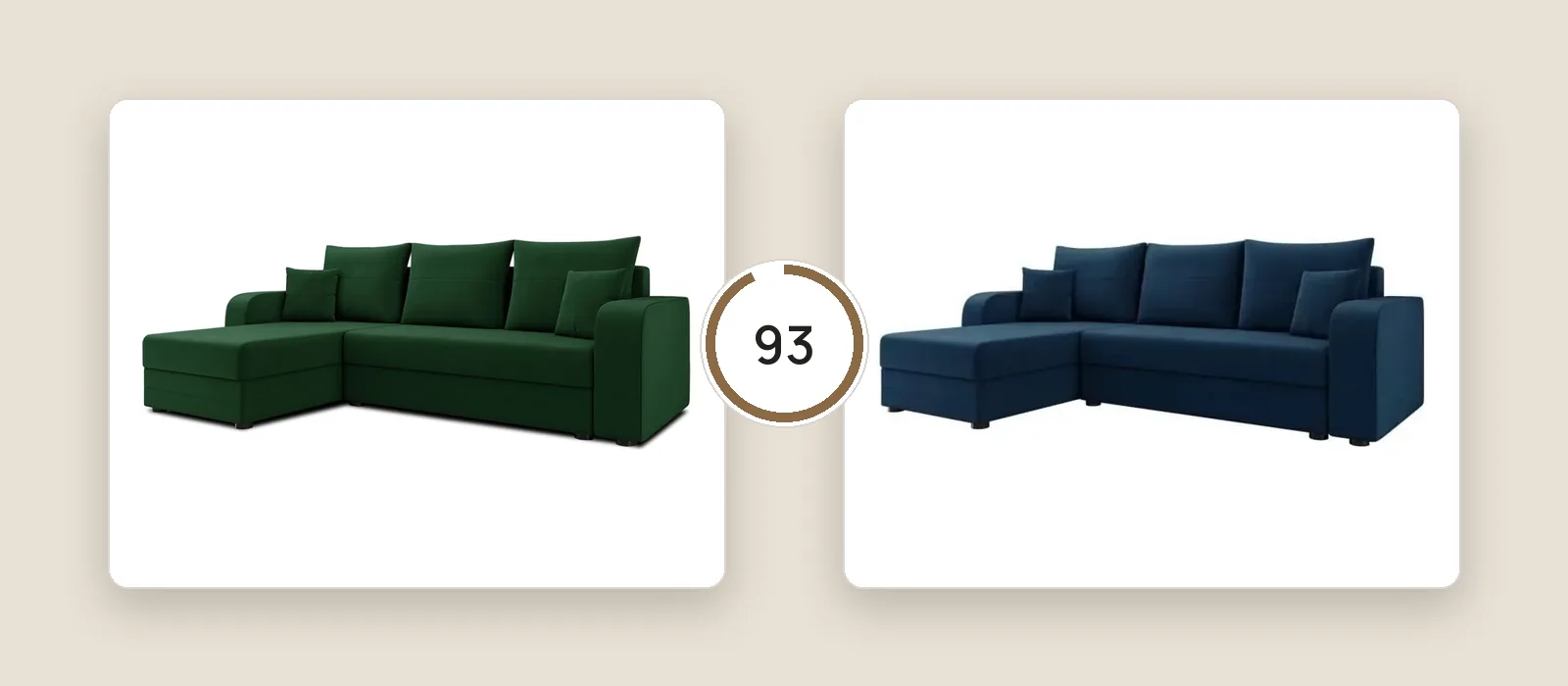
- A score weighting photo similarity, text and specifications.
- Human validation of pairs close to the threshold, keeping every decision to improve the model.
Better to show nothing than a doubtful match: a false pair produces a false price gap, then a bad decision.
Classic traps
- Color variants. One model offered in five colors should count once.
- Sets. A set of four chairs at €320 compares with a single chair at €80, not €320.
- Package dimensions, mistaken for the furniture's own.
- Corner configurations, as a left-hand and a right-hand corner are not always interchangeable.
- Your own product resold on a marketplace, which is not a competitor.
Sources
- GS1, “Global Trade Item Number (GTIN)”. www.gs1.org/standards/id-keys/gtin
- Google Merchant Center Help, “GTIN [gtin]”. support.google.com/merchants/answer/6324461